

“Were you born with ‘it’?”

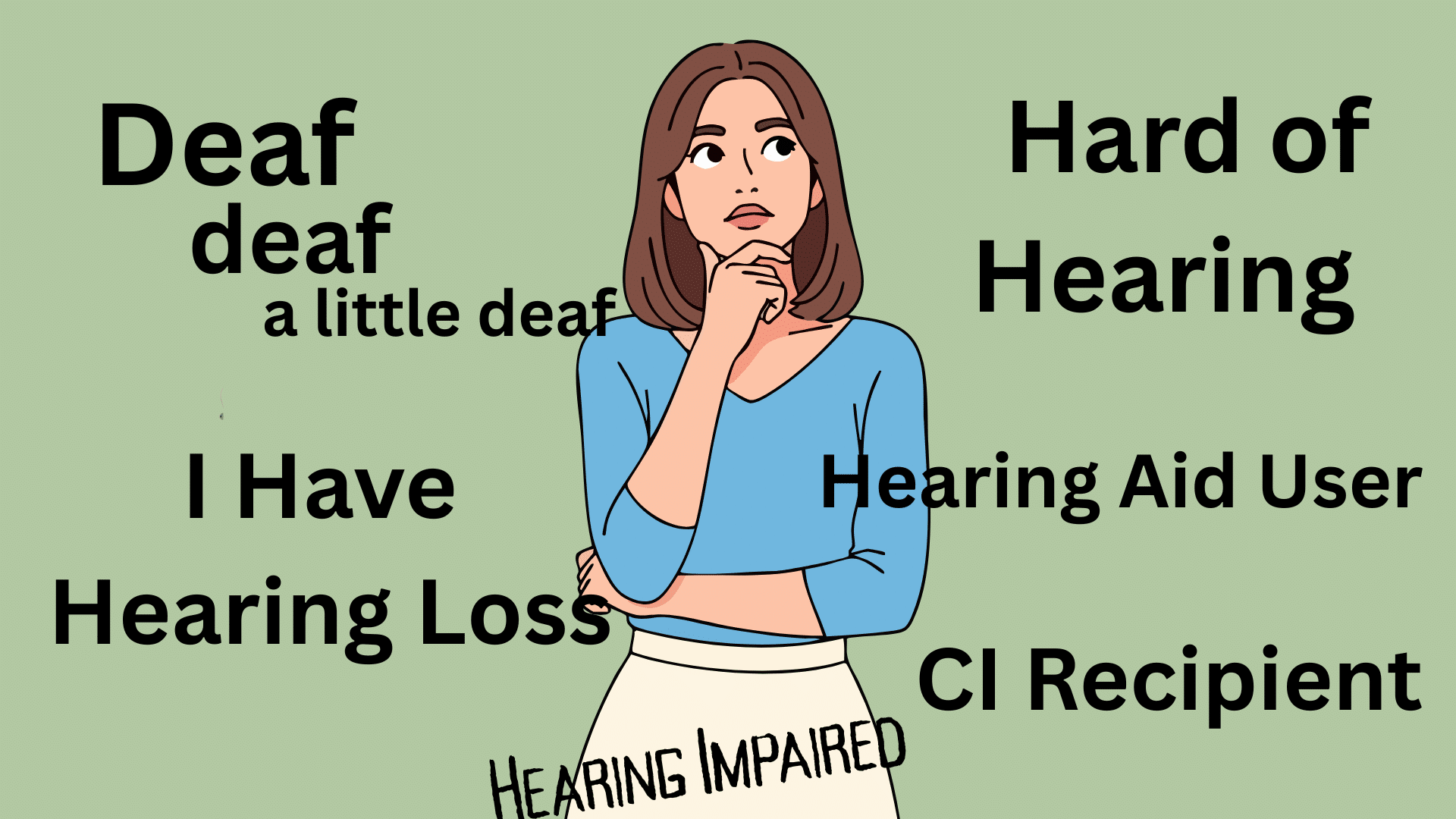
I get this question a lot when I, and my hearing loss, meet someone for the first time. Sometimes they ask hesitantly, not sure what to call ‘the problem’, which they indicate with little finger jabs at their own ear.

Talking about hearing loss is usually one of my favorite things to do, and I’m drawn like a bug to the light by anyone wearing a hearing aid. (Aha, one of my people!) When someone asks me about hearing loss, either mine or generally speaking, they often get more information than they expected or wanted.  How long the discussion lasts depends on my mood, whether the person is really interested, how much time I want to spend with this person, or how quickly they cut me off. “Gee, how nice, thanks for sharing.”

The Short Discussion is usually conducted with strangers, as a ‘sidebar’ to a conversation when I’ve had to ask the person to repeat themselves or speak up.

“Uh, how long have you had ‘it’?”

“All my life.”

“So, you were born with it, then?”

“Yes.”

“Oh, wow. Do they know what..you know…?”

“Caused it?”

“Yes.”

“No.”

The Long Discussion might take place at social gatherings or at work where there’s more time to chat with a new friend or colleague.  And Long Discussions are the backbone of consumer hearing loss conferences where people love to share their stories – and where you are honor-bound to sit through many tales of lifelong hearing loss and a traumatic recitation of past, horrible hearing aids. But the payoff comes when they are done and you can launch into your own hearing loss history, which they in turn must sit through, to the end! Luckily, most people and their stories are interesting, and there are useful tips to be learned from experienced hard of hearing people. (“Do not, as I did”, one person told me, “EVER put your hearing aid on the kitchen shelf while you are making a pie, or it too may be baked at 350° for one hour.” No danger of that, as I don’t bake.)

But I have come to understand why some people prefer to keep the fact of their hearing loss to themselves unless absolutely necessary. There are times – and this is a big confession for an avowed hearing health advocate – when I’m simply not in the mood to discuss my hearing loss or anyone else’s. Sometimes I’m just too impatient to handle the stream of well-meant questions that I’ve answered a thousand times before. This includes the jokers who, when I ask them to speak up, fire back a “pardon?” and then expect me to laugh as if it were the first time I’d ever heard this corny joke. (You have to be careful, though.  Last week an airline check-in staffperson dished back a ‘pardon’ and, because I wanted to humor her into letting me pre-board, I just laughed at her joke. Turned out she was hard of hearing and I did some fancy footwork to show I was not an insensitive traveler who should be stuffed in the overhead compartment.)

Other inner sigh-inducing questions:

How old is your hearing loss?   (73)

Really? How old ARE you?  (59…)

Where did it come from?  (An airborne virus)

How many ears is it in?  (Three)

Do you use that sign language?  (Just the cussing signs. Wanna see one?)

Is there anything that can be done for it?  (Cooked spinach, but I can’t stand the stuff.)

Do you read lips?  (Yes, but not yours.)

OK, can you guess what I’m saying?  (Oh, Holy Mother o’ Fred, kill me now!)

In my experience, people asking questions are truly interested in your hearing loss and for several reasons:

  • They are amazed at how ‘normal’ you look and/or how ‘well’ you speak.
  • They suspect a personal hearing loss and are digging for useful information
  • They have a close family member with hearing loss who is driving them crazy and they need to vent.
  • They’re nicer than you and simply curious about life.

The occasional bad mood aside, I welcome these questions because the conversation often circles back to their hearing issues.  There was a time when I was the one in need of information and this is an opportunity to pay it forward – to encourage the person to seek professional hearing care, to recommend a hearing loss consumer group, to suggest some  informative websites.

And with all these questions, both the simple and the silly, what people are really asking is – I am struggling with the loss of hearing in my life; how are things going to change for me and am I going to be OK?

And the best thing we can do is say, “Got a minute? Let’s chat.”


Gael, 2 (Age of Diagnosis)

Gael, 2 (Age of Diagnosis)

Yo, hearing care professionals!  Hey, hearing loss groups!  In your area, where can a family sign up for a communication strategies course? (And I’m not talking about mandatory programs involving a psychologist or the police.)

It’s tough enough for a hard of hearing person to find access to effective aural rehabilitation, let alone a program that includes communication partners like spouses and children past the spit-up stage.

The need is great. In many families, hearing loss is the elephant in the room, the monkey wrench thrown into family communication.  Attending even a single facilitated session on communication strategies can make a big difference in the quality of family life.  I know what you might be thinking – and to keep this animal analogy going – you can lead a horse to water but you can’t make it drink. People may not break down the door to sign up for the session or course, but the ones who do will find it life-changing.

It can be a bit lonely as the only HoH in the house. Just because a family is well-versed in effective communication strategies, doesn’t mean it actually practices them. This is not because of pettiness, negligence or a lack of caring, but simply because family members, in the moment, can forget the basics of good communication. A turned-away face or a question bellowed from upstairs can suck the pleasant air out of a room in two seconds flat, kick-starting a familiar scenario of rising irritation and heated words.

Me:   Why did you do that?

Him:  (sigh) Do what?

Me:   You started talking to me as you walked away. You KNOW I can’t understand when you do that.

Him:  Sorry, hon, I forgot.

Me:   You forgot, you forgot! How many times will it take before you remember..?

Him:  Until death do us part, OK? I will always forget sometimes, I can’t help it. Now, do you wanna know what I said, or not?

Hearing loss is a family affair. Its impact reaches beyond the personal to anyone within communicating distance. In my house, even after years together, simple mis-communications can still spark reactions ranging from an irritated laugh to full-on frustration. This is part of our more-or-less accepted family dynamic, and when the bad moment passes, we move on – time after time.

But the family affair has recently become more complicated.

One change involves the 17-year-old son who has already moved beyond our sphere of influence. The little boy who was raised to respect the gift of hearing and understand the consequences of hearing damage now enjoys his music at dangerous levels. There’s not much I can do beyond offering a supply of earplugs, which I can no longer stuff in his ears for him, and reminding (nagging) him that if he continues to abuse his hearing, we’ll be comparing hearing aids at some point in the future.

The other change involves his parents. Up until now, Mommy has been the only one playing in the hearing loss sandbox. But now Daddy may have stuck a toe into the sandbox, too. When it’s noisy, he doesn’t hear me as well as he used to. Recently, at a hearing health fair I was involved with, my husband signed up for a free hearing test. Although the testing environment was less than ideal, his hearing was ‘normal’ until 4000 Hz – and then kaboom, the famous noise damage notch!

The day may have arrived when the (former) Hearing Husband and I must practice two-way communication strategies. I now need to practice what I preach, making sure, for example, that he can see my face in order to understand what I’m saying.

But my husband and I have grown into this situation – I was already hard of hearing when we got married. What about the couples or families who experience hearing loss after years of being together? The emotional impact is often immeasurable. Internet resources such as personal blogs and consumer/professional hearing loss sites offer a great deal of helpful information, but don’t match the effectiveness of learning and practicing good communication strategies with real people.

Clients will be more successful, if hearing care professionals also help their families deal with the emotional barriers of hearing loss, clearing the way to better communication with real-life strategies that work.

The time is ripe to introduce family communication sessions. If a hearing professional in my area cares to offer one, I’ll sign up me and my boys. A good family dynamic is dependent on many things and handling hearing loss is definitely one of them.

family