


Tuition costs of AuD degrees at public and private schools were the topic of the first two posts in this series. In the beginning, before residential programs, Transitional programs were the most widely used means to obtain an AuD, though they are now being phased out.
Today’s post summarizes their story and their costs. For a more complete history, be sure to check out the recent series of posts on Globalization of the AuD Degree in Hearing International.
What is a “Transitional” AuD Degree and Who Can Get One?
Two practical issues loomed with the creation of the AuD: how to get the profession behind the degree and how to get working professionals their doctoral degrees. The two issues were intertwined. Academic programs had to change, but which changes were required depended, at least initially, on how existing Audiologists were upgraded to the doctoral level.
One cheap but highly controversial solution was to grandfather in working professionals with an “earned entitlement” AuD at a cost of $750 through the now-disbanded Audiology Foundation of America (AFA). It’s difficult to say how many AuD (EE)s are in the field, as the AFA did not publish a tally when it ceased operations. If anyone has that number, Hearing Economics welcomes your input.
A more workable, but also more time-consuming and expensive, solution is the topic of today’s post: Transitional AuD programs. Transitional programs were created for working professionals with Master’s level credentials. These programs enabled practicing Audiologists to return to the classroom to complete AuD requirements via distance education formats.
As planned, most transitional programs closed over the past few years, as the transitioning window for Master’s level practitioners came to a preordained end. At present, the only two programs that continue to maintain distance-learning components and grant Transitional AuDs are A.T. Still University (ATSU) and the University of Florida.
How Much Was that Transitional Degree Again?
After spending the last two posts examining the costs of Residential (full-time 4 year) AuD programs, it is staggering to contrast them with tuition for Transitional programs, not because of their high cost, but precisely the opposite (see Figure below).
No argument, those who went through Transitional programs to complete their AuDs scored the best deal (economically speaking) by a long shot. And that’s just the accounting cost view, not including opportunity costs for residential students.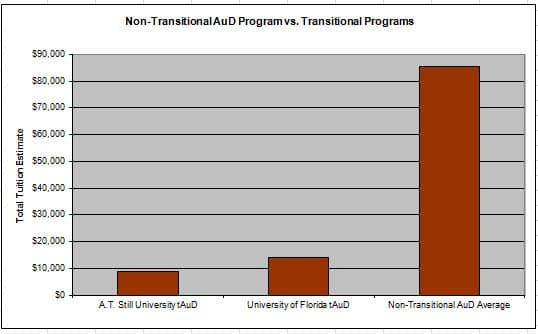
According to our estimates, there is approximately a $70K difference in total cost between a transitional AuD and a residential AuD program. Due to a transitional degree being done primarily while an individual is still working, there should be no additional “cost of living” expenses like that of a full-time student who doesn’t have the luxury of getting a regular salary.
If we consider even the most conservative estimates for annual cost-of-living to attend a residential AuD program, the differences in total cost between a transitional degree and a residential degree is likely to exceed $100K. If you went through a Transitional program to complete your AuD education, you got the best deal (economically speaking) by a long shot.
Are We Comparing Apples and Oranges?
The answer depends on your viewing position. Regardless of track, the end result is an AuD with all the requisite trappings. The issue of concern in this series is ROI on education investment for students.
Educators and institutions are concerned with quality, curricula, and a host of other reasonable lines of discussion for designing AuD programs, all of which affect tuition costs. Their views and needs constitute a different economic market and set of analyses in a different series. But for now, it’s sufficient to say that institutional needs and student needs are not the same economically.
As for apples and oranges, Residential programs have replaced Transitional programs, which implies progress and improvement. But just because it’s a “transitional’ degree doesn’t make it any less of a degree. Transitional programs are accredited and they are/were taught by many of the same professors who now teach in Residential AuD programs. Depending on the individual’s time commitment and motivational level, they can usually complete their degree in approximately 18-24 months.
Ultimately, audiologists with a Master’s degree who obtain their transitional AuD are committing about the same ‘total’ time to their degree as a full-time residential AuD student (approximately 4 years, considering a Master’s takes about 2 years to complete).
Onward
Next week’s post will summarize what we’ve found so far. We’ll see if it brings us any closer to answering our Big Question:
Is the return on investment in an AuD degree worth the (growing) cost?
*image courtesy of Michelangelo; photo courtesy of sculpture gallery
Kevin Liebe, AuD, is a clinical audiologist in private practice in Richland, WA. He currently chairs the Government Relations Committee of the Washington State Academy of Audiology. Dr Liebe has written other posts at HHTM.