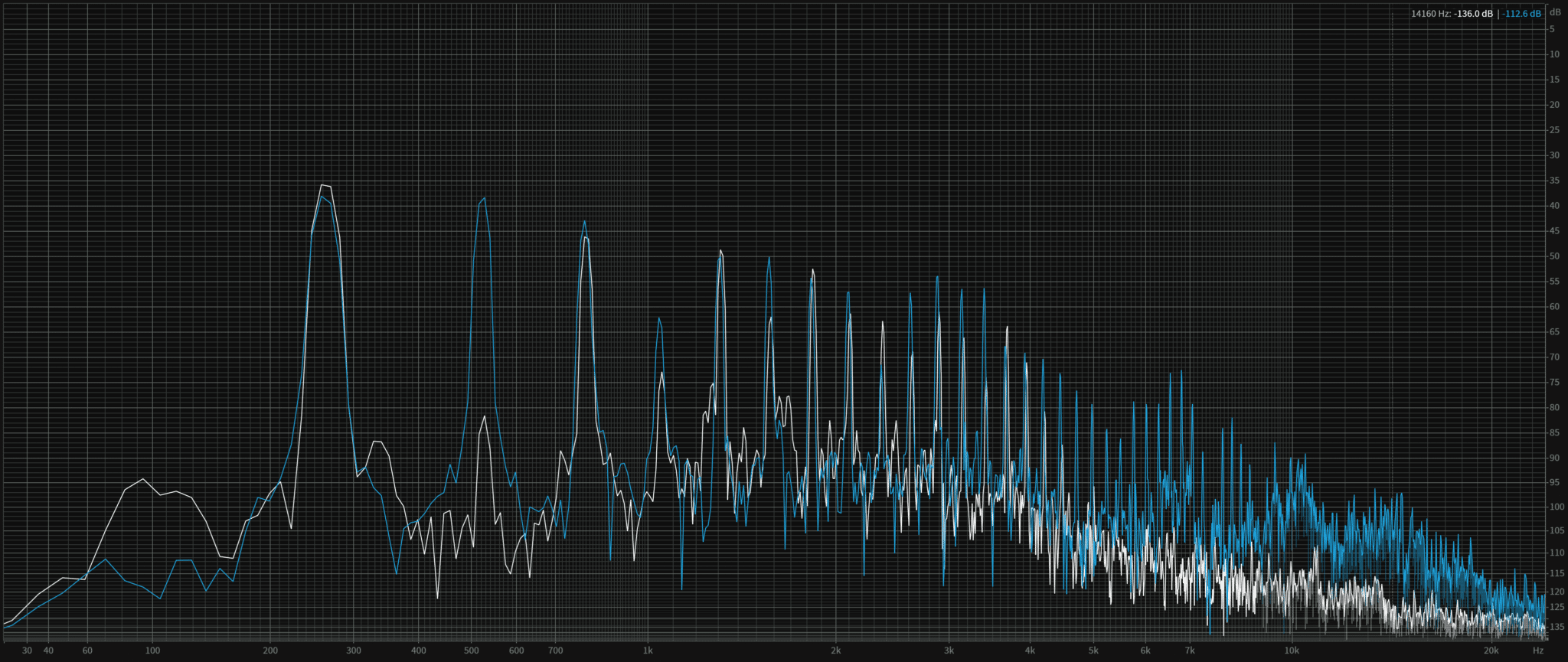



Whenever one measures the attenuation of hearing protection, it is different for every frequency.  This has to do with the rule of acoustics – generally lower frequency, longer wavelength sounds do not “see” an ear obstruction such as an earplug or earmuff as well as the higher frequency, shorter wavelengths.  Subsequently, lower frequencies have relatively little attenuation (typically no more than 25 dB at 250 Hz) whereas higher frequency sounds can be reduced by 30-35 dB.  Having a single number to represent this non-uniform attenuation is like saying that a person with a mild to moderate sloping audiogram has a 20 dB (or should it be 60 dB?) hearing loss.

Single numbers are convenient, but sometimes we lose sight of some of the simplistic assumptions that are behind such a number.  I frequently receive phone calls and emails from colleagues who want to know if a hearing protector with single number rating of 26 dB is adequate for a certain noise level (typically measured in dBA).  My pat answer is I have no idea – if you send me a spectrum of the noise and the frequency-by-frequency attenuation of the hearing protector, I can do the subtraction for you.  I am actually quite good at subtraction and received an A- in that subject in grad school.

Ideally, that is what we should be doing:  subtract the frequency-by-frequency attenuations from the spectral levels at those corresponding frequencies.  This will provide an estimate of what actually reaches the worker or musician and can inform us about whether the attenuation is sufficient, too much, or too little, and also at which frequencies corrections should be made.

For some reason, this was considered too difficult for some, so single number rating schemes were invented.  There are several “single number” rating schemes in use around the world.  In many parts of Europe the Single Number Rating (SNR) scheme is used.  In North American the NRR takes the cake.  The NRR is the Noise Reduction Rating and is now about 35 years old.

This is how it works…

The NRR is the noise (C-weighted) – noise (A weighted) + attenuation (A-weighted) – 3 dB – 2 standard deviations.

Don’t panic!  If there is minimal low frequency spectral energy below 1000 Hz such as in many forms of treble music, the first two terms cancel out (noise [C-weighted] – noise [A-weighted]), so we are left with the actual attenuation and then we get to subtract off estimates of how poor the hearing protection can actually be if worn poorly.  This last series of correction factors is actually quite brilliant and seeks to estimate a worst-case scenario.

If the hearing protector was uniform in its attenuation, such as the ER-15 Musicians Earplugs, the NRR formula would yield an unfairly low number for the earplug (because the attenuation would be measured in A-weighting).  The ER-15 attenuates all sound by 15 dB but it has an NRR rating of about 10 dB.

To be accurate, however, the Environmental Protection Agency (EPA) in the United States requires the NRR number only for non-custom products.  So, let’s take another musicians’ earplug that has a relatively flat or uniform attenuation – the ETY from www.etymotic.com.  This one-size-fits-all earplug (actually, it’s now two-sizes-fit-all: a standard and a large) has an attenuation characteristic that ranges from about 18 dB for low frequency sounds to about 22 dB for high frequency sounds.  The associated NRR would be about 12 dB.  There is nothing “12 dB” about the ETY earplugs.

Also, if the musician was instructed properly on how to use it, the poorest fitting would not be as poor as a one-size-fits-all earplug in an industrial environment., and the penalty of “3 dB – 2 standard deviations” would not be as great.

Next week, part 2 will be a whimsical overview of how we may use a 2 number rating scheme that would be more useful for describing the attenuation characteristics of custom and non-custom hearing protectors.

I am constantly amazed by how similar the hearing of an 85-year-old who has never been exposed to noise and has never seriously played music is to the hearing of an 85-year-old retired professional clarinet player who sat down-wind of the trumpet section for more than 45 years.

If their hearing was measured when these two fellows were in their 40s, I suspect that the musician would have had greater hearing loss on an audiogram than did his non-musical colleague, but something happens in the last several decades of life that frequently covers up this noise or music-exposure history.  It’s as if presbycusis (hearing loss associated with aging) becomes  a much more dominant factor in the later years than music or noise exposure.

This phenomenon is nothing new, and it is well known by people who study large hearing loss data bases, also known as noise exposure “models”.  The effects of presbycusis appear to swamp the effects of other causes that affect the inner ear.  Some have referred to this as “asymptotic hearing loss,” meaning that over time, the deterioration still continues but gradually becomes less and less.  The greatest change from noise or music exposure may happen in the first 10-15 years of exposure and then only more incrementally after that.

We are not sure of the reasons for this but I can think of many possibilities ranging from auditory toughening, biochemical changes, the nature of damage to the cochlear hair cells, and so on.  I am not sure that something as multi-factorial as this phenomenon will ever be pinned down.

Nevertheless there are some things that we can still share with our clients, and here is what I usually say when they visit me clinically:

  • The audiogram is a very simple and gross measure.  Even though you have suffered some permanent hearing loss, this may still be only the tip of the iceberg.  This imparts at least a partial understanding that a normal audiogram doesn’t necessarily mean “normal” auditory function and that there are many locations in the auditory pathway(s) where subtle pathologies may occur.
  • Just because you already have some nerve damage in your cochlea caused by all of your music, you are no more, nor less susceptible than anyone else to future hearing loss. This is actually an empirical result of large scale meta-analyses where people with some hair cell damage are not any more susceptible to further hearing damage than anyone else.  Some (erroneously) may fear that their musical career is finished, and this is simply not the case.  Well, it may be finished but not for auditory reasons…
  • It’s not really the result on the audiogram that we should care about, it’s the other things that go hand in hand with hearing loss such as tinnitus, and pitch perception problems.  This helps to remind the musician that they still need to protect their hearing in order to prevent career threatening symptoms such as tinnitus.
  • Yes, you have a loss of sensitivity at 4000 Hz (which is near the top note on the piano keyboard), but you don’t have to change the equalization on your recording or change the equalization for their listening pleasure.  I am sometimes asked by recording engineers whether they should alter the equalization of their recordings in order to compensate for their audiometric hearing loss.  I could go into a description of equal loudness contours (a.k.a. Fletcher-Munson curves) and sometimes do, but I get to remind them that an audiogram is an artificial test where we are only measuring equally loud sounds (i.e., at threshold) which would correspond to the 0 phon curve.  An audiogram says nothing about supra-threshold auditory function where speech and music have their energy signatures.  The human auditory system plays “catch-up”  whenever there is a cochlear hearing loss so nothing needs to be done to offset the loss of sensitivity at 4000 Hz (or any other frequency), in most cases of mild (and perhaps even moderate sensorineural) hearing loss.

So, a visit by a 40-year-old musician means that they get to learn a lot about the role of our brain, hearing protection,  prevention of tinnitus and pitch perception problems, and a stroll through the wonderful world of equal loudness contours.